
Fibre Technologies GRC Guide
What is Glassfibre Reinforced Concrete?
Glassfibre Reinforced Concrete (GRC/GFRC)
Glassfibre Reinforced Concrete is a composite material composed of a cementitious matrix reinforced with fine Alkali-Resistant Glass Fibres.
This innovative material combines the strength and durability of concrete with the flexibility and lightweight properties of glass fibres. GRC offers architects and engineers a versatile solution for creating intricate architectural elements, facades, and structural components with exceptional strength and aesthetic appeal.


GRC Projects Around The World
GRC has been around since the 70’s and, since then, has been used on some of the most spectacular architectural designs around the world – just take a look at the One Thousand Museum in Miami or the Masdar Institute in Abu Dhabi, as examples.
You can find more GRC case studies on our website if you want to learn more about this material’s unmatched potential.
Variable Properties & Performance
GRC’s performance can differ greatly on several factors such as the production method, the mix design, and specifically, the type and quantity of Alkali-Resistant Glass Fibre used.
As indicated in this table, the two most popular methods of GRC application (Traditional Hand Spray & Spray Premix) offer varying mechanical properties so it is important to consider which production method is best suited for your project.
| Property | Units | Hand Spray | Premix |
|---|---|---|---|
| Fibre Content | Wt.% | 4 – 5 | 1.5 – 3.5 |
| Density (Dry) | g/cm³ | 1.8 – 2.1 | 1.8 – 2.1 |
| Flexural Strength LOP | N/mm² | 6 – 10 | 5 – 10 |
| Flexural Strength MOR | N/mm² | 18 – 30 | 5 – 15 |
| Compressive Strength | N/mm² | 40 – 70 | 50 – 80 |
| Tensile Strength UTS | N/mm² | 8 – 12 | 3 – 6 |
| Tensile Strength BOP | N/mm² | 4 – 6 | 3 – 5 |
| Thermal Conductivity | w/m°C | 0.9 – 1.5 | 0.9 – 1.5 |
| Thermal Expansion Coefficient | x10-6/°C | 7 – 12 | 7 – 12 |
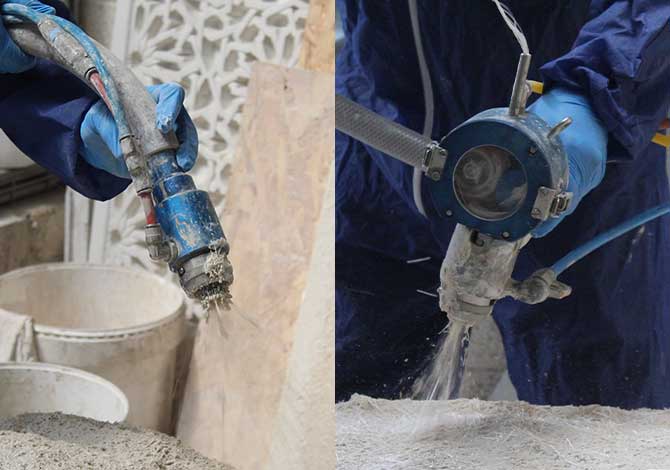
The MK5A and Concentric Spray Guns in action.
Traditional Hand Spray vs Sprayed Premix
The Traditional Hand Spray method, for instance, is known to achieve the highest strengths, thanks to a synergistic mix of high AR Glass Fibre content, low water-to-cement ratios, lengthy fibre strands, and a planar orientation of the fibres.
On the other hand, the Sprayed Premix method strengths generally fall short of those attained through Traditional Hand Spray although it is important to note it excels in other areas. One such example of this is its ability to provide consistent mechanical properties that match or exceed those of products made through the Vibration Cast Premix method, underscoring its effectiveness and adaptability in GRC production.


