The Masdar Institute
Abu Dhabi, UAE
- 2011 RIBA International Award Winner
- GRC2011 Award Winner
- Certified Gold by The Leadership in Energy and Environmental Design (LEED)
- Environmentally Sustainable Built Project Award Winner in the 2012 International Awards for Liveable Communities
The Masdar Institute is a bold statement of the capabilities of Glassfibre Reinforced Concrete in sustainable construction.
This innovative project, completed in 2011, was the first phase in development of Masdar City – the world’s first carbon-neutral, zero-waste desert community. Powered entirely by renewable solar energy, the community remains independent of any power grid, generates 60% of its own energy needs, processes its sewage and dry waste on-site (which is recycled) and pioneers many energy saving concepts.
This initial stage in development was built to house the city’s first residents, consisting of students and researchers, and will act as the educational heart of the city, providing a catalyst for the rest of the masterplan.
The materials chosen for the project needed to align with the sustainable approach outlined in the project’s proposal which led to the selection of Glassfibre Reinforced Concrete (GRC).
Project Scope
Architects, Foster + Partners, worked to design a bold, experimental project rooted in a sense of place, shaped by the specific climate of Abu Dhabi. The form of the campus’ buildings are inspired by traditional desert settlements, which are compact and oriented so that the buildings provide shade and channel cooling air currents throughout the complex.
The masterplan of Masdar City is to establish a ground-breaking sustainable urban community, and the Masdar Institute was to act as the experimental initial phase of construction.
The project itself will change and evolve over time – already it houses twelve separate pilot research projects for energy generation with potential world-wide applications. The overall design is flexible enough to respond to these new technologies, anticipating things which have yet to be invented – many of which will be developed in the Masdar Institute itself.
Challenges
Sustainability was at the forefront of every choice in the design of the Masdar Institute which reflects in the challenges that the main contractor and design team faced during the design and construction process.
The following were just some of the challenges involved in the project:
- A resource-efficient approach would be required to create the residential unit facades – poor management of resources would be considered unsustainable
- The harsh conditions of the desert climate needed to be taken into account – the buildings would require ventilation and insulation to lower the interior temperature without the need for environmentally harmful air conditioning
- A prolonged material transportation process would increase the carbon footprint of the project, so materials needed to be sourced locally
- Moreover, a lengthy installation time that would require frequent use of heavy machinery would even further increase the project’s carbon footprint
Glassfibre Reinforced Concrete Application
It was the sustainable context of the Masdar Institute project that led to the selection of GRC as a construction material. GRC is renowned for its sustainable attributes – its supreme longevity, resource efficiency, insulative properties, lower carbonation & permeability, and weather resistance.
The main purpose in selecting GRC was to negate any need for long-distance material transportation and the associated carbon emissions caused by this. GRC’s lightweight and modular nature allowed for products to manufactured locally in Abu Dhabi, reducing transport times and expediting installation times.
The deployment of state-of-the-art GRC materials and spraying techniques enabled the GRC to be produced with an optimum percentage of fibre in the mix, resulting in the reduction of its already low carbon footprint. To ensure the GRC demonstrated the lowest possible carbon footprint, even the materials and process used for the moulding of the panels were assessed. One such example of this was the use of silicone as a liner to form the voids, creating a decorative pattern in the panels. The silicone was then able to be recycled for use in other moulds.
To provide a fast-track solution for the residential unit facades, several GRC panels were combined to create larger sized panels, thereby reducing the number of moulds and joints between panels.
The nature of these panels meant that they could be delivered to site as ‘one-piece’ units and simply and efficiently lifted and bolted onto pre-installed brackets before being lined and levelled. Erection of the balcony units used across the design were originally projected to take up to 10 days to install for each residential unit, but the GRC facade modules ultimately used were fixed in place within only 2 hours.
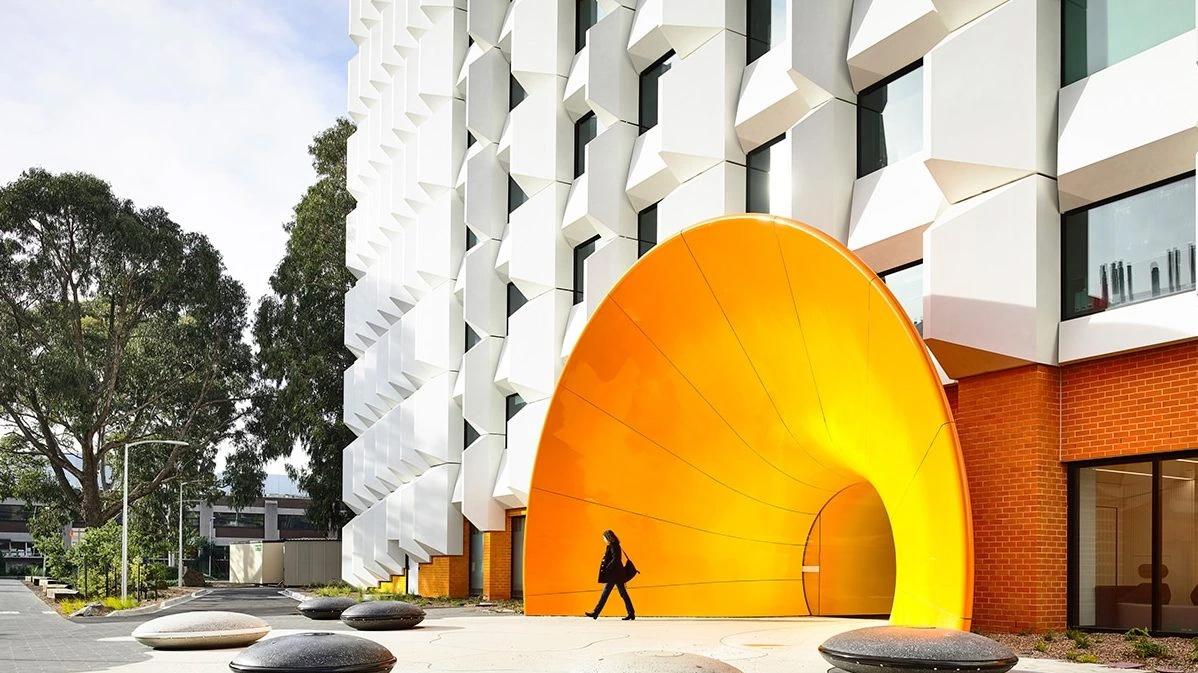
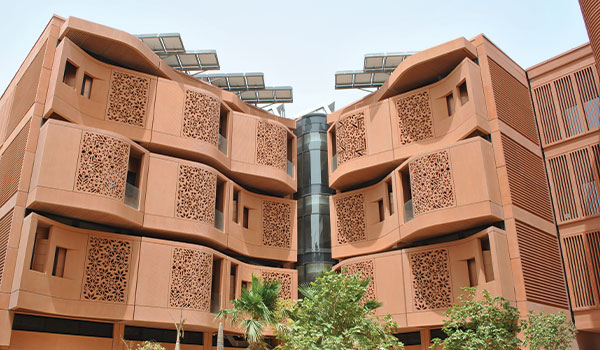
Staggered, undulated facades were used for the residential units to provide self-shading from the high sun. These patterned screens were designed by Jean-Marc Castera – utilising curved forms to provide directed oblique views from narrow streets while maintaining privacy. These contemporary reinterpretations of the mashrabiya screen draw on octagonal symmetry and avoid monotony with patterns developed at different scales to allow the screens to have a degree of depth visually. The moulding possibilities of the GRC fabrication allowed for this to show through in the final installed elements, where the main areas of the GRC panels are typically only 25 to 30mm thick.
Flourosilane sealer was applied to the face of these GRC panels to provide a waterproof surface that also proved beneficial in reducing the unsightly visual effect of sand adhering to the facade after sandstorms.
The resulting structure is a stunning example of eco-friendly construction that utilised GRC to great effect in meeting the project’s sustainability goals.

Conclusion
Masdar City is on course to becoming one of the world’s most innovative works of construction, with this initial phase already receiving a multitude of awards, including the 2011 RIBA International Award and the GRC2011 Award.
As sustainability becomes a more pressing issue in construction, it’s important for architects, engineers and specialists to look towards the Masdar Institute as an example of using innovative materials and techniques to achieve sustainability goals – notably, the use of Glassfibre Reinforced Concrete.
So, if you’re looking for a clear demonstration of how GRC can be used to great effect in sustainable construction, then look no further than the Masdar Institute.
Fibre Technologies and Power-Sprays can provide all the materials and equipment you need to manufacture GRC products for sustainable construction projects. Find out more by viewing our range or getting in touch, we’re here to help.