
GRC Advantages
The 10 Reasons Why Glass Reinforced Concrete Is Superior To Conventional Concrete
Now’s The Time To Use This Revolutionary Material
When comparing Glass Fibre Reinforced Concrete with its conventional concrete contemporary, the advantages of GRC are immediately apparent. From its eco-friendly properties to aesthetically-pleasing appearance, GRC represents a diverse range of benefits for all manners of uses.

1 – Lightweight Products
Despite having a density similar to concrete, Glass Fibre Reinforced Concrete achieves remarkable weight reduction due to its thin 10-15mm skin thickness.
For instance, a cladding panel made from 100mm thick precast concrete would weigh 240kgs per m², while a similar GRC panel weighs only 40-50kgs per m².
Moreover, many GRC products can be easily lifted and carried by hand, a crucial aspect given the stringent manual handling regulations in numerous countries.
2 – Eco-Friendly
As sustainability quickly becomes a more pressing issue, GRC emerges as an excellent eco-friendly alternative to conventional concrete.
The AR Glass Fibres at the core of the composite allows for a more resource-efficient approach without having to sacrifice the strength of the material – no longer are steel reinforcements or increased quantities of cement required.
Studies have shown that when compared with its precast concrete equivalent, GRC has a far lower environmental impact by a factor of as high as 60%.
3 – Durability & Longevity
GRC structures are known for their exceptional longevity, often achieving a lifespan exceeding over half a century with minimal maintenance requirements.
Even under significant loads and stress conditions, GRC panels maintain structural integrity over time. The reinforcement provided by the AR Glass Fibres enhances the tensile strength and flexural performance of GRC, reducing the likelihood of cracking and structural failure.
4 – Superior Strength
Due to the implementation of AR Glass Fibres, GRC can attain far superior strength than conventional concrete whilst requiring far less resources.
Unlike conventional concrete, GRC can produce far superior mechanical properties without the need for larger quantities of cement. Yielding results with 30% greater tensile strength than steel, the use of AR Glass Fibres also negates the requirement for steel rebar reinforcement.

5 – Appearance
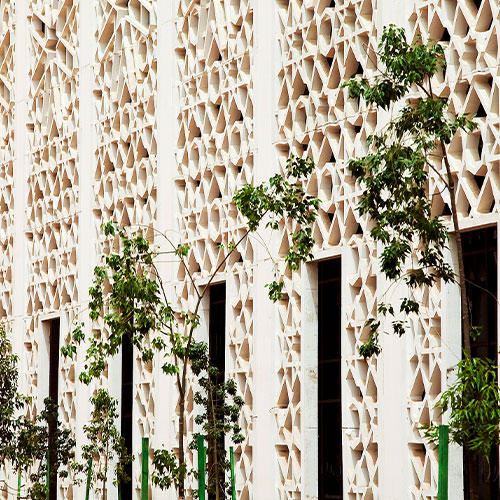
GRC has a wide flexibility in design and manufacture, which enables it to reproduce most architectural styles and features.
It can replicate virtually any surface detail and reproduce the appearance of materials such as stone, slate, terracotta, and marble.
This approach to producing stonework features proves far more efficient than producing carved stonework. Since its carved-counterpart involves specialised skills and is slow to produce, the end product ultimately ends up being very expensive. On the other hand, GRC stonework can be efficiently produced whilst matching the appearance of traditional stonework. It can also be produced in thin sections, making it easier to handle and fix.
6 – Cost-Effective
Glass Reinforced Concrete products have been shown to provide economic solutions to many applications.
While the initial manufacturing costs of GRC may be higher compared to conventional concrete, the overall savings become evident when factoring in reduced handling, transport, and fixing expenses. Not to mention, the minimal maintenance requirements for GRC structures allows for long-term savings, further solidifying GRC as a cost-effective choice for diverse applications.
7 – Weather Resistant
GRC’s unique ability to withstand all manners of environmental factors make it an exceptionally useful material in harsher climates with unpredictable weather conditions.
The material exhibits resistance to a variety of factors such as:
Freeze-Thaw Cycles – GRC’s low porosity and dense matrix make it highly resistant to freeze-thaw cycles, preventing damage caused by expansion and contraction of water within the material.
Chemical Exposure – GRC’s composition can be engineered to resist chemical attack from acids, alkalis, and other corrosive substances, making it suitable for applications in industrial environments and coastal areas.
UV Radiation – GRC formulations with UV-resistant additives can withstand prolonged exposure to sunlight without degradation, ensuring long-term colour stability and aesthetic appeal.
8 – Insulation Properties
One such factor that contributes to GRC’s position as an eco-friendly material is its incredible thermal insulation properties. Due to its low density and potential for incorporating lightweight aggregates, GRC demonstrates insulative properties that can lead to improved energy savings in buildings by reducing heating and cooling loads.
Thermal conductivities in GRC panels vary but can achieve levels as low as 0.9-1.5 w/mºC.
9 – Incombustible
Glass Fibre Reinforced Concrete formulations are designed to meet stringent non-combustible standards mandated by UK and EU regulations, ensuring compliance and safety in construction applications.
While Polymer GRC doesn’t qualify as non-combustible, it meets the rigorous Class O requirements specified by British Building Regulations, offering reliable fire performance.
10 – Corrosive & Rot Proof
Due to the AR Glass Fibres in the composite, GRC products do not need mild steel reinforcement, evading the corrosion issues and rust-related structural deterioration associated with steel.
As mentioned, unlike conventional materials, GRC is resistant to external elements such as moisture, sunlight, and chemical exposure, ensuring structural integrity even in harsh environments. This durability translates to reduced maintenance requirements and long-term savings for users.


