The Essential Guide to Alkali Resistant Glass Fibre
What is Alkali Resistant Glass Fibre?
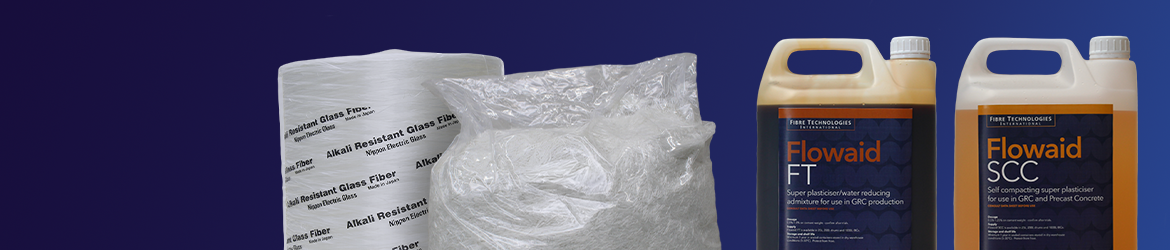
Alkali-Resistant (AR) Glass Fibre is the key component of Glassfibre Reinforced Concrete’s (GRC) versatile and durable composition.
By incorporating these fibres, manufacturers can create thin and robust products that demonstrate far superior mechanical properties over conventional concrete – all without the need for larger quantities of cement. Moreover, these fibres yield results with 30% greater tensile strength than steel, which negates any requirement for steel rebar reinforcement.


The essential difference between AR Glass Fibre and E-Glass Fibre is the zirconia content/alkali-resistance of the fibre.
Fibre Technologies only stocks NEG ARG Fibres which are all manufactured using the same glass composition with a zirconia content of over 17% – the highest of any commercially available Alkali Resistant Glass Fibre. This high zirconia content is vital in maintaining the integrity of the fibre in the alkaline cement matrix. Without these alkali-resistant properties, the fibre would quickly degrade in the concrete mix and result in a catastrophic loss of tensile strength.
See Figure 1 & 2, above, demonstrating the effects of cement on ARG Fibre and E-Glass Fibre.

Photo Credit: Nippon Electric Glass Co. Ltd.
How is Alkali Resistant Glass Fibre Produced?
Alkali Resistant Glass Fibre is produced by drawing multiple filaments of molten glass through small openings in a specialised plate known as a ‘bushing’. As the glass cools, the filaments are bundled together, and a coating (or ‘size’) is applied to bind them into strands.
The diameter of the filaments is controlled by the size of the holes in the bushing, typically ranging from 10 to 20 microns. In GRC production, the number of filaments per strand can vary from 50 to over 400, with the most commonly used ranging between 100 and 300.
The composition of the size is crucial and has been developed to meet the specific requirements of various applications. By the adjusting the number of filaments and the type of size, manufacturers can create a range of AR Glass Fibres tailored to suit specific applications.
From here, the fibres are either prepared as roving or chopped strand.
To produce roving, strands are spun into a cake and then placed in a dryer. Once dried, the strands from multiple cakes are combined and wound together to create a roving. The size, which binds the filaments, is formulated to soften upon contact with water, assisting the bond with cement and allowing for easy compaction of the GRC during rolling.
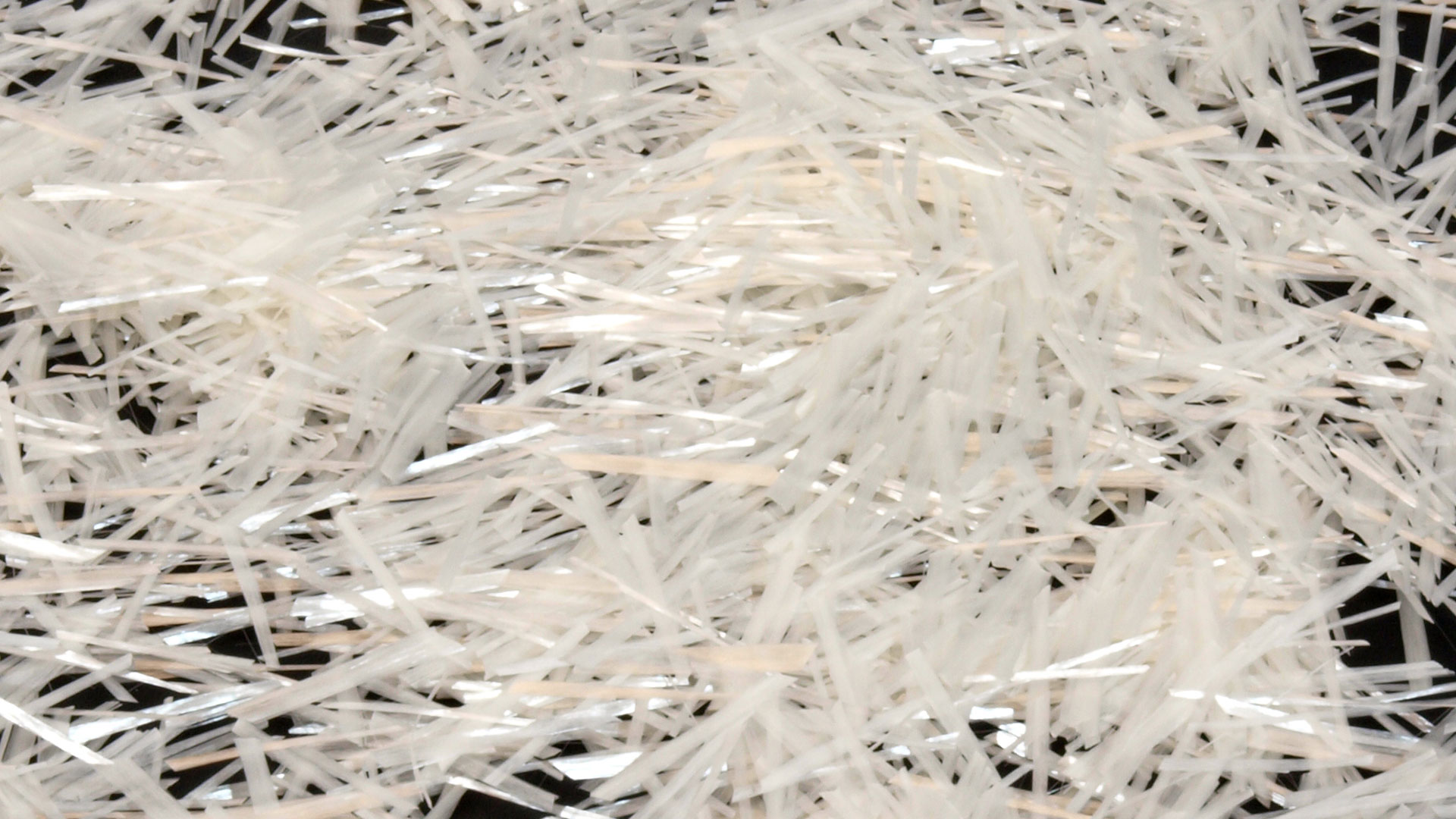
To produce chopped strand, the continuous strands are cut into various lengths. The size is designed to keep the filaments bound as integral strands throughout the mixing process. ¹

Alkali Resistant Glass Fibre Roving
AR Glass Fibre roving is the most versatile form of fibre, allowing manufacturers to create GRC products using spray or premix methods.
Roving is primarily used in traditional hand spray, where the fibre and cementitious slurry are simultaneously sprayed through a specialist spray gun, ensuring chopped fibre is efficiently distributed throughout the mix. This even distribution means that products created using this method tend to attain the highest strengths. The elongated fibre lengths and planar fibre orientation are also attributable to this method’s high strengths.
Despite primarily being used for traditional technique, with the use of a single or multi-roving glass fibre chopper, manufacturers can produce premix GRC products.
Rovings are labelled in the following format:

In some cases, a letter X or Y may appear at the end to indicate the number of filaments making up one strand:
- X = 200
- Y = 100
The absence of a letter indicates 200 filaments per strand.

Popular Rovings
The most commonly used types of roving fibres are:
- AR2500H103 – The relatively soft sizing of this fibre makes it ideal for most hand-spray operations. In many cases, it is the only fibre that some hand-spray manufacturers use. It is ideal for architectural products due to being easy to roll and compact in corners and complex shapes. This fibre is not suitable for premix GRC; however, the nature of the size causes strands to rapidly disperse into filaments when in a concrete mixer, making it an ideal crack control fibre.
- AR2500H200 – This fibre is much stiffer and has advantages when used to produce flat products via automated and semi-automated processes. The stiffness of the fibre means that it can also be used in premix GRC.
- AR5000H530X – Primarily used in premix GRC. This fibre can either be chopped directly into the mixer using a multi-roving chopping system or pre-cut and added to the mixer manually. Premix manufacturers use this roving since it has almost half the packed volume of chopped strand, making it far cheaper to transport and store.
- AR2500H350Y – Can be used for either spray or premix GRC. As the Y indicates, this roving is a 100 filament-per-strand fibre, providing twice as many reinforcing strands as conventional fibre, ensuring effectiveness at lower fibre contents. For spray, it can be used at 3.5 – 4.5% to give equivalent strengths to 5% conventional fibre. For premix, it is used at 1.5 – 2.5%.
- AR5000H350Y – A higher tex version of AR2500H350Y. In a given time, twice as much fibre is chopped and sprayed when compared to 2500 tex fibres.

Alkali Resistant Glass Fibre Chopped Strand
AR Glass Fibre chopped strands are cut fibres engineered for reinforced concrete and other cement-based materials. These strands disperse uniformly throughout mixes, significantly enhancing tensile strength and impact resistance.
Ideal for sprayed premix and various other GRC applications, chopped strands improve the overall durability and structural integrity of concrete products. Although these methods may fall short of the strength attained via traditional hand spray, they can excel in other areas such as their ability to provide far more consistent mechanical properties.
Chopped strands are labelled in the following format:

In the case of ‘Type of Size’, a H indicates a high integrity size used in most GRC applications whilst an S indicates a dispersible size used in applications where individual strands are preferred.
In most instances, a letter X or Y will appear at the end to indicate the number of filaments making up one strand:
- X = 200
- Y = 100
The absence of a letter indicates 200 filaments per strand.
Popular Chopped Strands
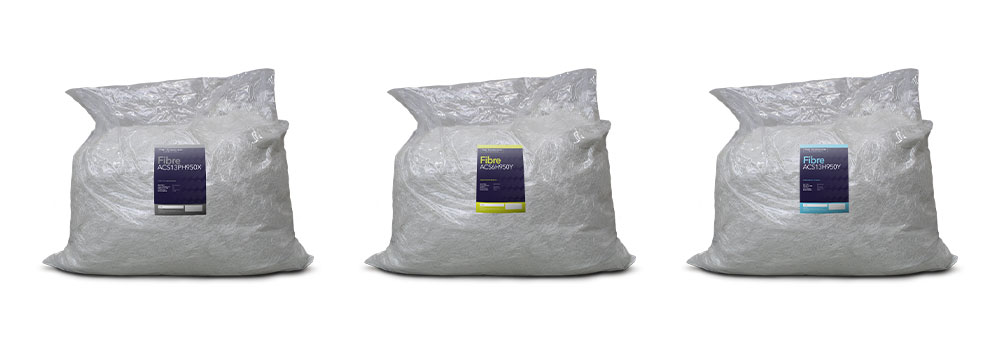
The most commonly used types of chopped strand fibres are:
- ACS13H950Y – Demonstrates good strand integrity during mixing and is very effective at lower fibre percentages (1.5 – 2.5%). The new H950 sizing has improved workability, allowing less water or more fibre to used for the same fluidity.
- ACS13PH950X – Formed from 200no. 18micron diameter filaments, this chopped strand has the highest integrity and high fibre percentages can be added without adversely affecting the workability. This fibre is also resistant to overmixing.
- ACS6H950Y – Specialised for premix GRC and reinforcing cement renders, this fibre has excellent strand integrity and is very effective at lower fibre percentages (1.5 – 2.5%).


Choosing the Right Fibre
Glassfibre Reinforced Concrete’s performance can differ greatly depending on the type and quantity of Alkali Resistant Glass Fibre used, mix design, and the method of production, so it’s vital that GRC manufacturers carefully consider their options before beginning production.
It is also of the utmost importance to ensure that any AR Glass Fibre being purchased is compliant with industry standards.
According to the GRCA, there are 4 simple rules to follow to verify this:
- Choose a reputable manufacturer and brand.
- Demand a Certificate of Conformity to the relevant standard. In Europe, this is EN 15422 and, in the USA, it is ASTM C1666.
- Ensure a Quality Certificate or Certificate of Analysis indicating the zirconia content is provided with each batch of fibre.
- Verify that the product ordered is the most suitable for your chosen production process. Discuss this with the glass fibre manufacturer or their local stockist to ensure this.²
To produce GRC products that demonstrate high-performance mechanical properties, we highly recommend using NEG ARG Fibre. Fibre Technologies stocks large quantities in both chopped strand and roving forms which are available worldwide through our international network of distributors.
For any questions on which fibre will best suit your project requirements, get in touch with our expert team.