© Elemental Architecture, LLC.
Shepard Hall Restoration
New York, USA
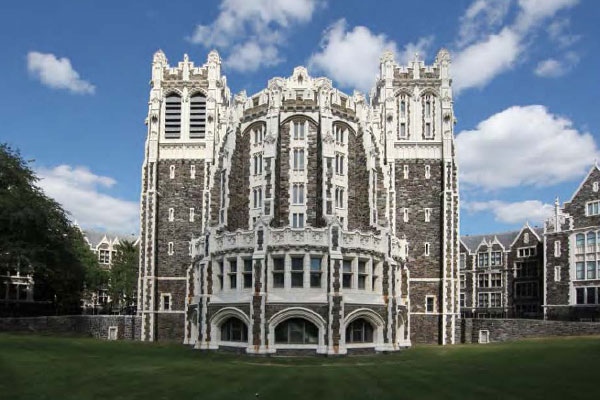
Since 1907, Shepard Hall has stood as the centrepiece of City College of New York’s main campus. An ornate figure of grand proportions, its neo-gothic stylings of pointed arches, soaring towers and intricately carved facades imbue the structure with a dramatic, cathedral-like presence. The richly ornamented exterior houses a grand, high-ceilinged space which, much like the city it serves, ‘never sleeps’ – ever open and accessible, allowing visitors to explore its storied halls, adorned with grandiose décor of stain-glassed windows, murals, busts and portraiture.
Designed by architect George Browne Post and built over a period of over 4 years, Shepard Hall became the first building constructed for public higher education in the United States. Over the decades, it has welcomed students of all backgrounds into its halls and has even hosted speeches from some of history’s most influential figures, including Albert Einstein, Woodrow Wilson and Franklin Roosevelt.
Yet – despite its storied history and academic significance – towards the end of the 20th century, this prestigious building found itself falling into a state of disrepair.
© Elemental Architecture, LLC.
Project Background
Post’s elaborate glazed terra cotta facades are much of what endows Shepard Hall with such dramatic grandeur, yet it was the degradation of these same elements that led to the structural decay of the building.

© Elemental Architecture, LLC.
The fatal error of the design was the lack of expansion joints or means to accommodate thermal movement – consequently, as the building moved, the terra cotta was crushed. With the brittle façade cracking and crumbling, rainwater began to seep into the substructure, severely corroding the steel beneath and causing expansion – widening inlets for water to further damage the underlying steel. Subsequent structural failures occurred where, in extreme cases, pieces of terra cotta weighing over 10kg were falling from heights of more than 30m.
© Elemental Architecture, LLC.
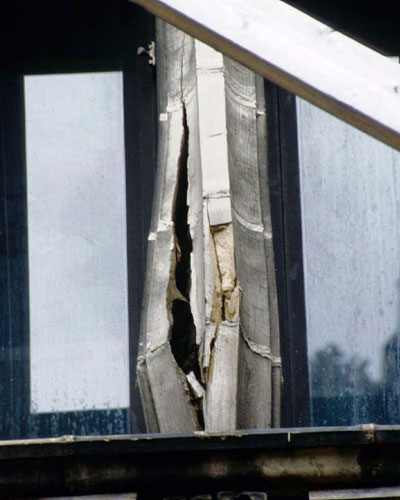
Pictured: Much of the original terra cotta had suffered from severe structural degradation
By the late 80s the situation had reached a critical impasse: structural degradation had become so widespread that the entire building was in danger of collapse. Over one-third of the original terra cotta elements had failed whilst the steel members embedded in the masonry were exhibiting signs of failure with indications that some had entirely rusted away. Moreover, efforts to remove and replace the failing terra cotta with brick and stucco were already exhibiting signs of failure themselves.
Restoration work would need to be comprehensive if the building was to survive.
Restoration Work
Reconstruction of Shepard Hall proved to be a lengthy process spanning several decades, largely due to the sporadic funding of the project, resulting in a fragmented construction schedule. Research, design and construction by The Stein Partnership (now Elemental Architecture) began in 1986 led by Carl Stein, who remained the principal-in-charge throughout the project.
Following the realisation that the entire building shell would need replacing, a Feasibility Study was carried out to identify criteria for the replacement cladding. This study revealed three important points that informed the material selection. Firstly, the material would need to be compatible with an attachment system in which each replacement unit would be independently supported. Secondly, the material would need to be formed into thin units with a nominal material thickness of 16mm. And finally, the material needed to precisely replicate the details and monolithic appearance of the façade.
What material could meet all three of these exacting requirements?

© Elemental Architecture, LLC.
GRC Replicas
It was Glassfibre Reinforced Concrete (GRC) that emerged as the material of choice to replicate the fine detail and solid appearance of the terra cotta, its mouldability allowing for the near perfect replication of a vast array of elements including incredibly complex and nuanced shapes and sculptural imitations.

© Elemental Architecture, LLC.
Piece by piece, the terra cotta was removed and replaced with either brick or stone, set about 10cm behind the finished surface. GRC replicas of the terra cotta forms were then attached to the new masonry using a system of galvanized steel channels and clips, allowing for adjustment in three planes. The joints between these GRC units and the masonry were designed and implemented as such that they could accommodate approximately 2.5mm of movement thus avoiding the same crushing motion that had destroyed the old terra cotta.

© Elemental Architecture, LLC.
Pictured: GRC elements – left installed 1995, middle installed 1999, right installed 2005 – all produced by different fabricators over a decade yet demonstrating remarkable visual consistency
Despite the disjointed project timeline, units installed in each phase of construction maintained a visual unity – a GRC unit installed in the 80s demonstrated the same appearance as one installed a decade later. This consistency is even more remarkable when considering that, over the course of the project, the GRC units were produced by four different suppliers and fabricated in seven different production plants.

© Elemental Architecture, LLC.
Conclusion
Following decades of meticulous restoration work, the final GRC units were installed in 2013, marking an end to this colossal project.
The Shepard Hall restoration has since validated GRC as the material of choice for complex historic construction and is a practice that is becoming increasingly widespread. Other materials simply cannot match the myriad benefits of GRC – its ability to replicate the texture and appearance of heritage materials, lightweight nature enabling installation without imposing significant additional loads and durability ensuring long-lasting protection against weathering and environmental damage.
For more information on this outstanding project, you can view Carl Stein’s full presentation on the GRCA website.
If you’re looking for the specialist equipment and materials required to produce the remarkable composite that is GRC, you’ve come to the right place. Explore our range below or send us an email for more information.