Self-Compacting Concrete & Self-Compacting GRC: A Complete Guide
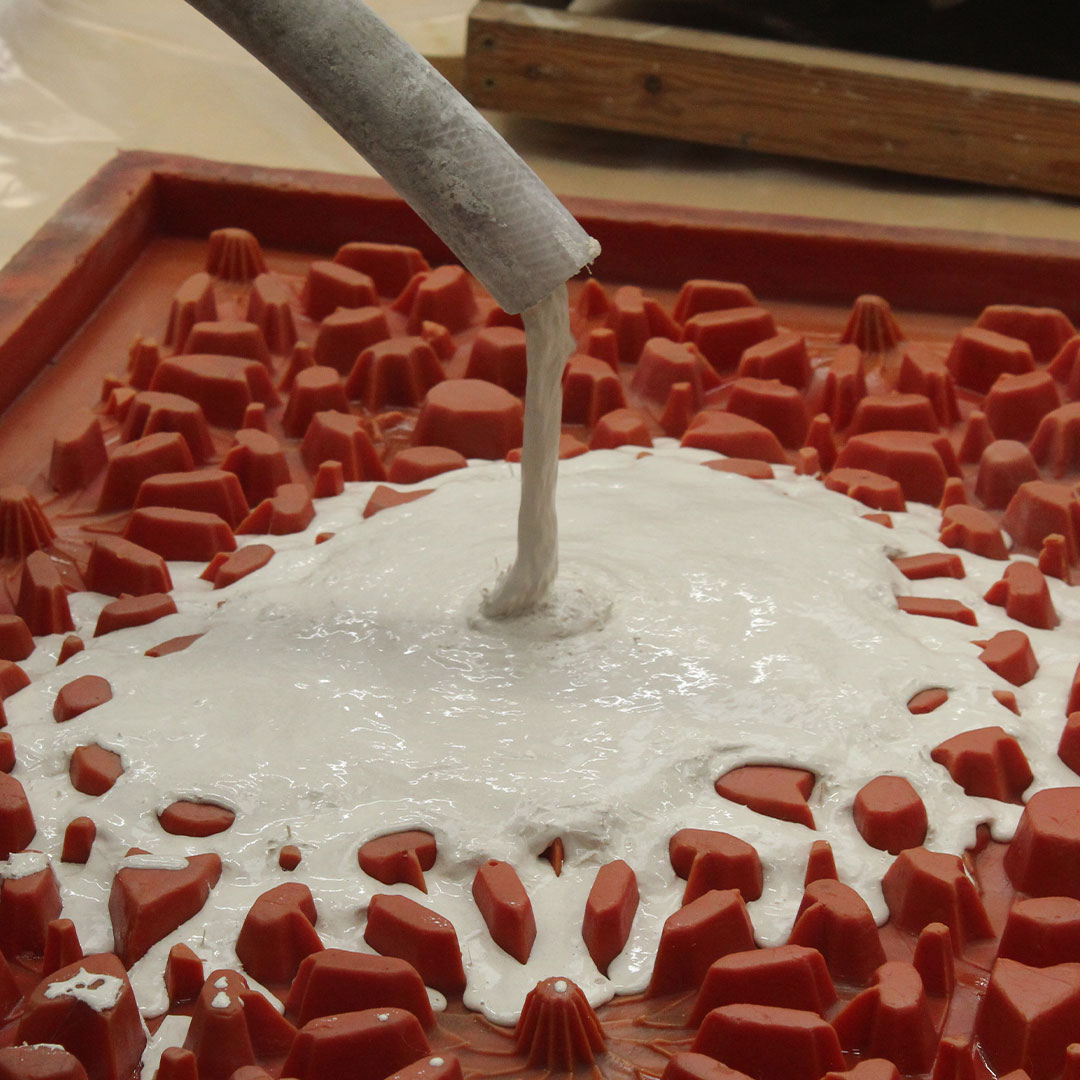
To ensure optimal appearance, strength and durability, concrete must be compacted properly. The traditional method of compaction is through vibration; however, this raises a number of issues, particularly in the health & safety of workers. A more innovative solution arose through the development of Self-Compacting Concrete (SCC). SCC mixes are designed to flow purely by means of their own weight, completely filling whatever receptacle the mix is poured into. The resultant cured concrete achieves an immaculate surface finish and is dense, homogeneous and embodies the same mechanical properties as vibrated traditional concrete.
To achieve a self-compacting effect, the typical concrete mix design of cement, aggregate, water, additives and admixtures must be altered to include a higher fine aggregate content and a specially adapted superplasticiser. This superplasticiser must be engineered to improve flow without causing segregation or affecting strength.
The use of Self-Compacting Concrete presents a quick, simple and effective method of producing a wide range of high-performance concrete products. Notable applications include formwork, underfloor heating, high-rise buildings, bridges and tunnels.
What is Self-Compacting Concrete?
To ensure optimal appearance, strength and durability, concrete must be compacted properly. The traditional method of compaction is through vibration; however, this raises a number of issues, particularly in the health & safety of workers. A more innovative solution arose through the development of Self-Compacting Concrete (SCC). SCC mixes are designed to flow purely by means of their own weight, completely filling whatever receptacle the mix is poured into. The resultant cured concrete achieves an immaculate surface finish and is dense, homogeneous and embodies the same mechanical properties as vibrated traditional concrete.
To achieve a self-compacting effect, the typical concrete mix design of cement, aggregate, water, additives and admixtures must be altered to include a higher fine aggregate content and a specially adapted superplasticiser. This superplasticiser must be engineered to improve flow without causing segregation or affecting strength.
The use of Self-Compacting Concrete presents a quick, simple and effective method of producing a wide range of high-performance concrete products. Notable applications include formwork, underfloor heating, high-rise buildings, bridges and tunnels.

The Benefits of SCC
Eliminating a reliance on vibration for compaction yields several benefits, notably improvements in health & safety. Prolonged use of vibration machinery is known to cause health problems such as Hand-Arm Vibration Syndrome (aka white finger), and the noise of the machinery can lead to hearing damage over time. By using self-compacting mixes, instead, this machinery can be eliminated. This leads to further benefits in cost-efficiency as savings can be made in labour and equipment hire.
Self-Compacting Concrete is also well-suited for more complex moulds and specialist applications. Underfloor heating is a great example of SCC’s suitability in the latter; an SCC mix can quickly and easily fill space around pipework whilst eliminating risk of potential damages caused by using vibrating plates.
Self-Compacting Glassfibre Reinforced Concrete
Much like traditional concrete, Cast Premix Glassfibre Reinforced Concrete (GRC) typically relied on vibration to fill moulds and remove entrapped air. However, GRC’s key component and reinforcing agent – Alkali Resistant Glass Fibre – causes certain issues using this methodology. Higher fibre content results in a poorly flowing mix, leading to incomplete mould filling and leaving a surface finish marred with air holes.
Progress has been made over the past couple of decades to develop a Self-Compacting GRC mix design that does not require vibration, is fluid enough to fill moulds, doesn’t segregate, forms a surface finish free from voids & air holes and possesses satisfactory mechanical properties.
Designing this mix proved challenging in early development, complicated by the high cement content of GRC. Moreover, the incorporation of certain superplasticisers, although achieving required flow, were also accompanied by segregation. To combat segregation, rheology modifiers were used but this adversely affected the mix flow.
The solution emerged when a special plasticiser was developed by Fibre Technologies: Flowaid SCC. This specialised plasticiser is chemically engineered with an integral stability agent which enables optimal flow without causing segregation.
Mix Design
A basic mix design for Self-Compacting Cast Premix GRC is as follows*:
| Material | Quantity |
|---|---|
| Cement | 25kg |
| Silica Sand | 25kg |
| Water | 9.0L |
| Flowaid SCC | 0.25L |
| ARG Fibre | 2% |
* Note: Alterations to mix designs, notably the fibre content, can yield widely varying flow and mechanical properties and should be tailored to suit applications.
** We should also note that a standard slump test isn’t suitable to measure the consistency of these mix designs as self-compacting mixes will cover the maximum number of rings. Rather, the mix consistency should be measured by flow rate.

Mechanical Properties
When formulating a Self-Compacting GRC mix design, a balance needs to be achieved between optimal flow and peak mechanical properties. AR Glass Fibre plays a key role in this balance.
In an experiment conducted by Fibre Technologies, it was found that a 36% increase in flexural strength could be achieved by doubling the fibre content from 2% to 4%. Findings also revealed that this strength could be improved even further by increasing the length of fibre. Although the flexural strength increased, this negatively impacted the flow properties of the mix. Further, the type of size and strand configuration/filament diameter also influenced mix flow.
A compromise must be made between achieving high fluidity and satisfactory flexural strengths. The key to achieving this balance is through using a high-integrity fibre in carefully deliberated quantities.
The results of our experiment revealed that Self-Compacting GRC is a viable alternative to vibration casting in terms of achieving satisfactory mechanical properties.

Conclusion
To properly leverage the capabilities of this specialised GRC, Self-Compacting GRC mix designs need to be carefully configured and a suitable plasticiser selected to enable optimal flow without causing segregation. What you need is Flowaid SCC: A superplasticiser specifically engineered for the creation of Self-Compacting GRC mixes, which eliminates segregation and significantly improves workability whilst reducing water content by up to 40%.
Explore our website or send us an enquiry to learn more about Flowaid SCC and Self-Compacting GRC mixes: